

![[subpage-banner/2_pamatkyaexpozice_1.png]](https://c.jewishmuseum.cz/images/subpage-banner/2_pamatkyaexpozice_1.png)
Spanish Synagogue: History, Architecture, Cultur
The Spanish Synagogue is the most recently built synagogue of Prague’s former Jewish Town and is widely regarded as its most beautiful. It is located on Dušní Street near both the Church of the Holy Spirit and the Franz Kafka statue (designed by by Jaroslav Rona). The synagogue was built in 1868 on the site of the Old Shul (Altschul) – the oldest house of worship in the ghetto – for the local Reform Jewish community
It acquired its name from its remarkable Moorish-style decoration, inspired by the famous Alhambra in Spain. The ornate gilding,
stained glass, and ornamental stucco arabesques create an interior that appears to shimmer with light.
History
The Spanish Synagogue was built on the site of the Old Shul (Altschul), which was demolished in 1867. It was designed by the architects Vojtěch Ignác Ullmann and Josef Niklas, with Jan Bělský in charge of construction. The unique Moorish-style décor was undertaken by Antonín Baum and Bedřich Münzberger between 1882 and 1883.
In 1935, a Functionalist annex with a winter prayer room was added, based on a design by architect Karel Pecánek. During the Second World War, the synagogue was used as a warehouse for confiscated property. Since 1955, it has been overseen by the Jewish Museum in Prague. It underwent reconstruction in 1958–1959 and again in 1995–1998, when it reopened to the public.
Architecture and interior
The building has a square ground plan with a large dome and built-in galleries. Its dominant feature is the Torah ark (Aron ha-Kodesh), stylized as a mihrab (niche). The interior features ornamental stucco arabesques, polychrome decoration, gilding, and stained glass. The synagogue’s exceptional acoustics are enhanced by an organ located in the southern gallery.
The present – exhibition and cultural events
The Spanish Synagogue forms part of the “Prague Jewish Town” sightseeing circuit. It houses the permanent exhibition “Jews in the Bohemian Lands, 19th–20th Centuries”, which focuses on Jewish emancipation, the Czech-Jewish and Zionist movements, the Hilsner Affair, the urban renewal of the Jewish Town, the Holocaust, and the post-war renewal of Jewish life.
The exhibition features distinguished figures such as Franz Kafka, Sigmund Freud, and Gustav Mahler. Highlights include a Hanukkah menorah from 1785 adorned with a portrait of Emperor Joseph II, as well as a map charting Jewish monuments in Bohemia and Moravia.
The synagogue is also a popular venue for chamber music concerts and other cultural events.
Visitor information
-
Part of the sightseeing circuit: Prague Jewish Town
-
Wheelchair access: yes (platform lift)
-
Services: ticket office, museum shop, restrooms
Noteworthy facts
-
The Spanish Synagogue never served a Sephardic community, nor followed the Sephardic rite.
-
The synagogue in Příbram was a smaller replica of the Spanish Synagogue.
-
The site is associated with František Škroup, the composer of the Czech national anthem, who played the organ in the former Old Shul.
Visit the Spanish Synagogue in Prague
– A unique monument where architecture, music, and Jewish history intertwine
Video & 3D tour
Where to find us
Vězeňská 1, 110 00, Prague 1
Frequently asked questions
What is the focus of the exhibition?
Jewish culture and history from the 19th–20th century.
Why is it architecturally special?
It features richly decorated Moorish Revival interiors.
Are events held here?
Yes, concerts often take place due to its excellent acoustics.
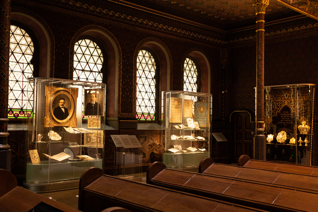
Španělská synagoga / Spanish Synagogue
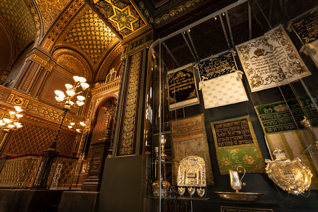
Španělská synagoga / Spanish Synagogue
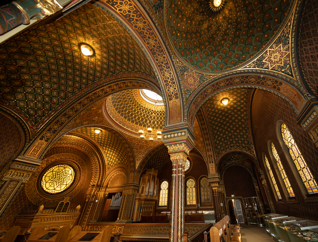
Španělská synagoga / Spanish Synagogue
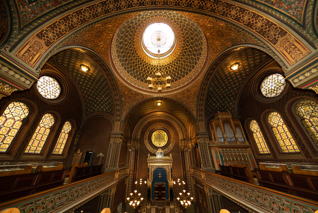
Španělská synagoga / Spanish Synagogue
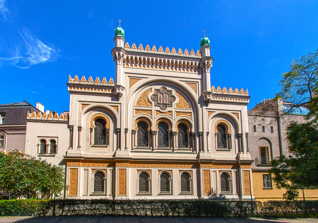
Španělská synagoga / Spanish Synagogue
![[design/2013/breadcrumb-arrow.png]](https://c.jewishmuseum.cz/images/design/2013/breadcrumb-arrow.png)
![[design/2013/fb-icon.jpg]](https://c.jewishmuseum.cz/images/design/2013/fb-icon.jpg)
![[design/2013/youtube-icon.png]](https://c.jewishmuseum.cz/images/design/2013/youtube-icon.png)
![[design/2013/Twitter.png]](https://c.jewishmuseum.cz/images/design/2013/Twitter.png)
![[design/2013/Instagram.png]](https://c.jewishmuseum.cz/images/design/2013/Instagram.png)

![[Incident2.png]](https://c.jewishmuseum.cz/images/Incident2.png)
![[homepage-banner/ENGbannerKohlovadiscount2018.jpg]](https://c.jewishmuseum.cz/images/homepage-banner/ENGbannerKohlovadiscount2018.jpg)